
🐌 Play slow version
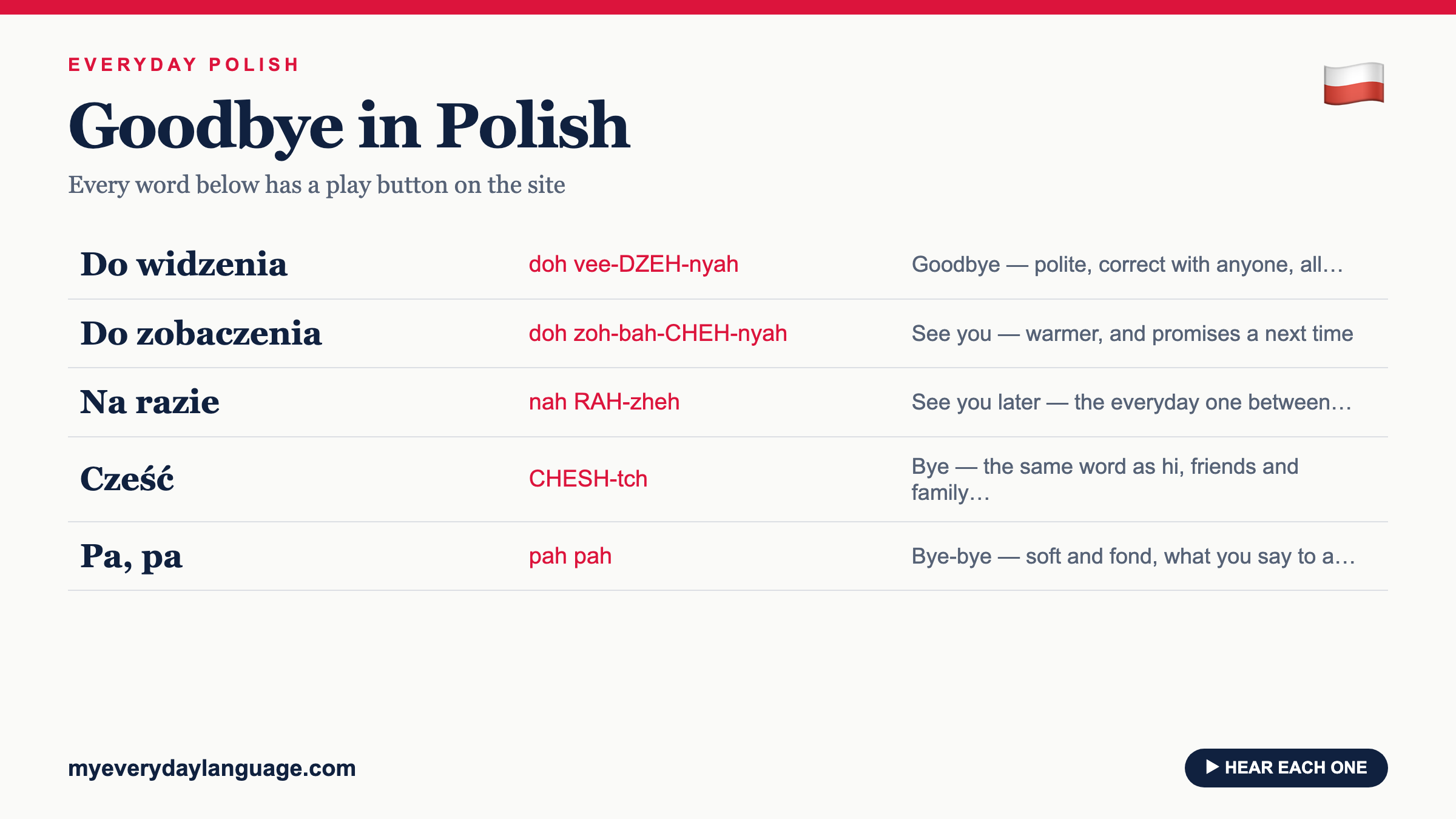
15 ways to say goodbye in Polish
| Polish | Say it like | What it means and when to use it | Listen |
|---|---|---|---|
| Do widzenia | doh vee-DZEH-nyah | Goodbye — polite, correct with anyone, all day long | |
| Do zobaczenia | doh zoh-bah-CHEH-nyah | See you — warmer, and promises a next time | |
| Na razie | nah RAH-zheh | See you later — the everyday one between people who know each other | |
| Cześć | CHESH-tch | Bye — the same word as hi, friends and family only | |
| Pa, pa | pah pah | Bye-bye — soft and fond, what you say to a child or on the phone | |
| Trzymaj się | TSHIH-my sheh | Take care — “hold on,” and the warmest way to end a visit | |
| Do jutra | doh YOO-trah | See you tomorrow — swap in any day you like | |
| Dobranoc | doh-BRAH-nots | Good night — only when the day is over for both of you | |
| Miłego dnia | mee-WEH-goh DNYAH | Have a nice day — said as you go, often after do widzenia | |
| Do usłyszenia | doh oo-swih-SHEH-nyah | “Until we hear each other” — for ending a phone call | |
| Szczęśliwej drogi | shchen-SHLEE-vey DROH-gee | Safe journey — for anyone getting in a car or on a plane | |
| Niech się pani trzyma | nyeh sheh PAH-nee TSHIH-mah | Take care, ma’am — the polite version. Use pan for a man | |
| Z Bogiem | z BOH-gyem | “Go with God” — old country, still said by the oldest generation | |
| Żegnaj | ZHEG-nigh | Farewell — heavy and final. Films and funerals, not front doors | |
| Nara | NAH-rah | Later — clipped slang for na razie, teenagers and texts |
Do widzenia or do zobaczenia? The difference in one line
This is the question people actually go looking for, and most pages skate past it. Here it is.
Both start with do, which means “until.” What changes is what you’re counting down to.
- Do widzenia is “until the seeing.” It’s neutral and polite, and it does not promise anything. You say it to the pharmacist, the ticket clerk, the doctor, the neighbor two floors up. It closes the door gently and asks nothing.
- Do zobaczenia is “until we see each other.” It says there will be a next time. Use it with people you expect to run into again — a colleague, a cousin, someone whose company you enjoyed.
Say do zobaczenia to a stranger you will genuinely never meet again and nothing bad happens; it just sounds a shade optimistic. Say do widzenia to a good friend and it lands slightly cool, like signing a text message with your full name. When in doubt with anyone you like: trzymaj się.
The long Polish goodbye
Now the part that will sound familiar to anyone who grew up in a Polish household in America.
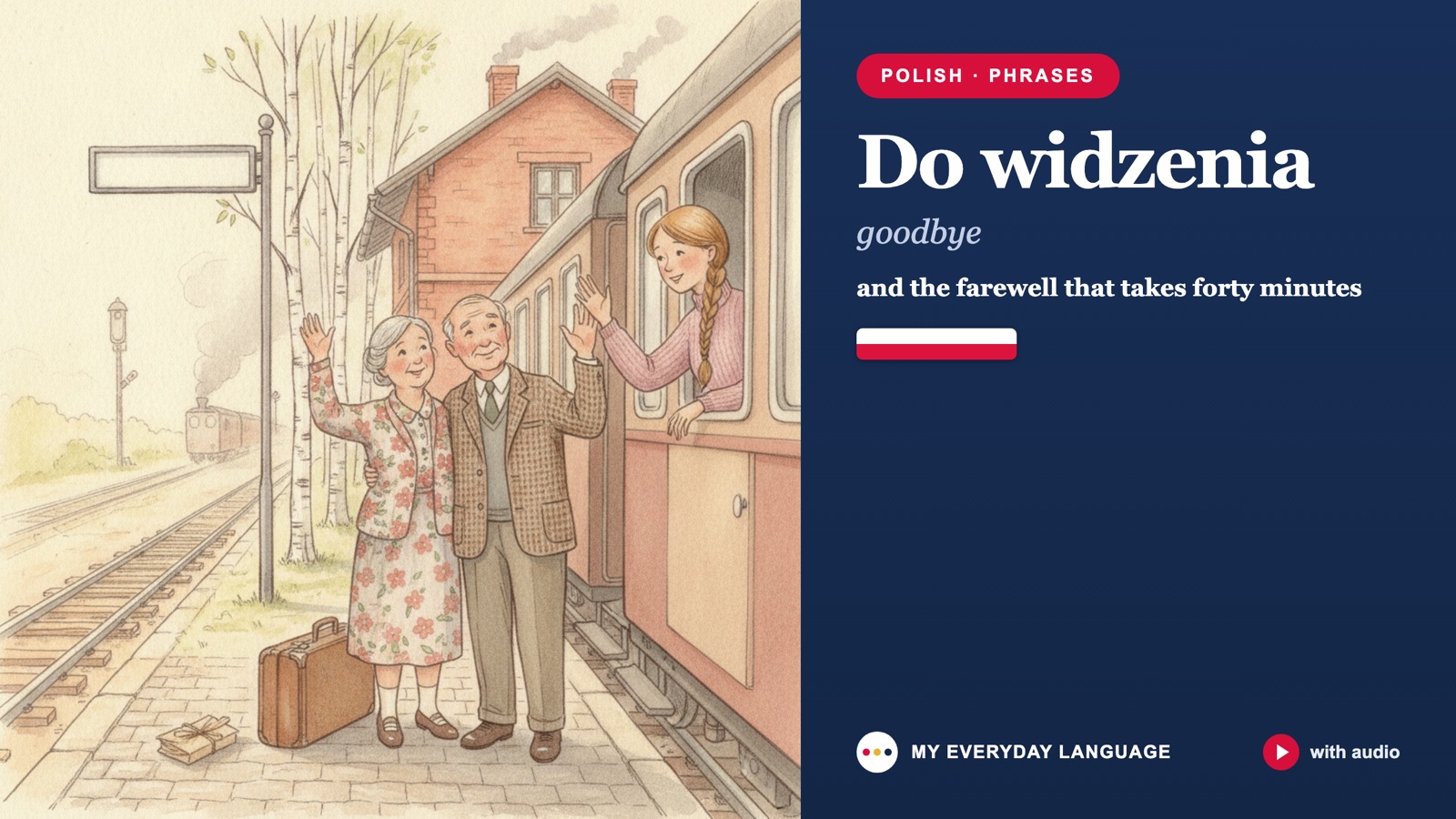
A Polish goodbye is not a moment. It is a phase of the evening, and it runs roughly forty minutes.
It begins at the table, where someone says they should really get going. Nobody moves. Then it moves to the hallway, where coats are found and immediately not put on, because a new conversation has started. Then the coats go on and the conversation continues, which means everyone is now standing in a warm hall in outdoor clothing, sweating slightly, discussing a cousin. Then the door opens, and the best material of the whole night comes out on the step, in the cold. Then someone is walked to the car. Then the car window comes down.
Somewhere in there, food is pressed on you in a container you are expected to return, which is a guarantee of another visit and also, frankly, the point.
If your grandmother was the last person out the door, she probably also said the thing at the end of it: z Bogiem — “go with God.” It came over with the first generation and stayed in the oldest voices. So did szczęść Boże (shchenshch BOH-zheh), “God bless,” which in Poland is a greeting, said to somebody working — a farmer in a field, a woman at a stove. In America it turned into a general blessing on the way out. If you heard either of these growing up, you were hearing a piece of village Poland that most of Poland has since let go of. The rest of what made that crossing is gathered in 15 Polish traditions families still keep.
Good night, safe travels, and the ones you save
Three of these are worth separating out, because using them at the wrong moment is the easiest mistake on this page.
Dobranoc is good night, and it means the day is finished for both of you — bedtime, or the true end of an evening. It is not an evening goodbye. Leaving a restaurant at nine o’clock you still say do widzenia. (Both ends of the day get a page of their own: good night in Polish and good morning in Polish.)
Szczęśliwej drogi — “happy road” — is for someone actually traveling. It’s the phrase for the airport and the driveway, and Poles mean it.
Żegnaj is the one to keep in a drawer. It’s a true farewell — the word for a parting you don’t expect to undo. It belongs to old films, war letters and the last page of novels. Say it to a friend at a train station and you will get a startled look, or a laugh, or both.
📬 Take this lesson with you
A tiny Polish lesson in your inbox every few days — words, audio, and a small story from everyday life. Free forever.
Join 1,700+ learners · unsubscribe anytime
Which one should you actually use?
Three will cover your whole life. Learn these and stop worrying:
- Do widzenia — for shops, offices, strangers, anyone older than you, and every situation where you’d rather be too polite than not polite enough. Add dziękuję in front of it and you sound like you’ve done this before.
- Trzymaj się — for anyone you’re fond of. It carries real affection without being sentimental, which is a very Polish combination. To an older person, make it niech się pani trzyma (or pana, to a man).
- Na razie — for friends, family and anybody you’ll see again soon. Light, easy, and the one you’ll hear most on a Polish street.
And cześć does double duty, exactly the way Italian ciao does — hello going in, goodbye going out. It’s covered from the arrival side on our page about saying hello in Polish, and the clipped young-Poland versions like nara live with the rest of the Polish slang.
If you’re assembling a small working kit of Polish rather than one phrase, the 25 basic Polish phrases page has the whole starter set with audio.
Practice: quick check
1. You’ve bought your bread and you’re leaving the bakery. What do you say?
2. You’re winding up a phone call with your cousin in Kraków.
3. Your grandmother’s friend, who is eighty-five, is showing you out.
4. You’re texting a friend you’ll see tomorrow.
Frequently asked questions
How do Polish people say goodbye?
What is the difference between do widzenia and do zobaczenia?
What is the Polish word for hello and goodbye?
Can you say “dzień dobry” at night?
Is “narazie” Polish for goodbye?
How do you pronounce do widzenia?
How do you say good night in Polish?
Keep going