
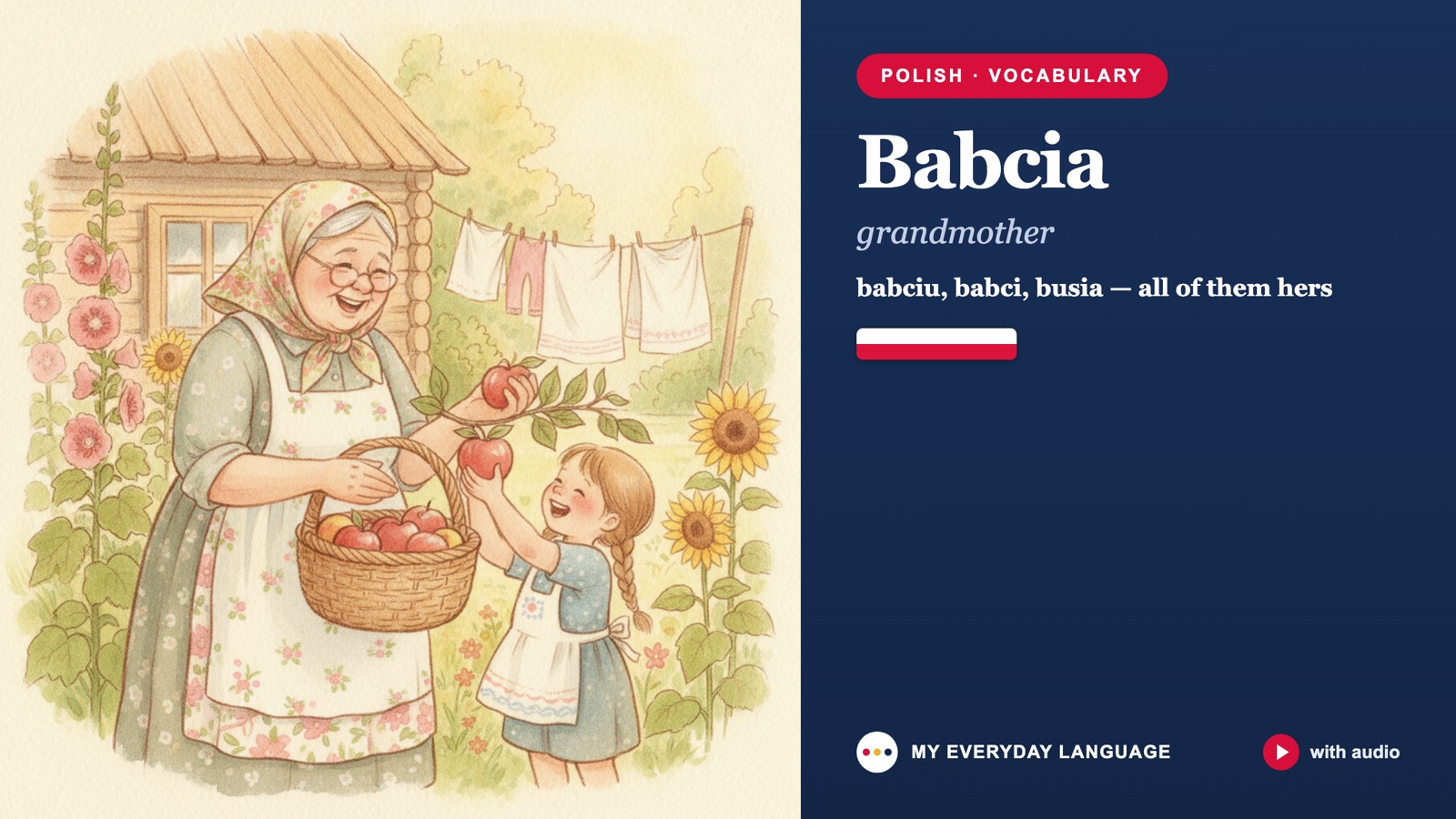
Polish › Vocabulary › Grandma
🐌 Play slow version
Every Polish word for grandmother
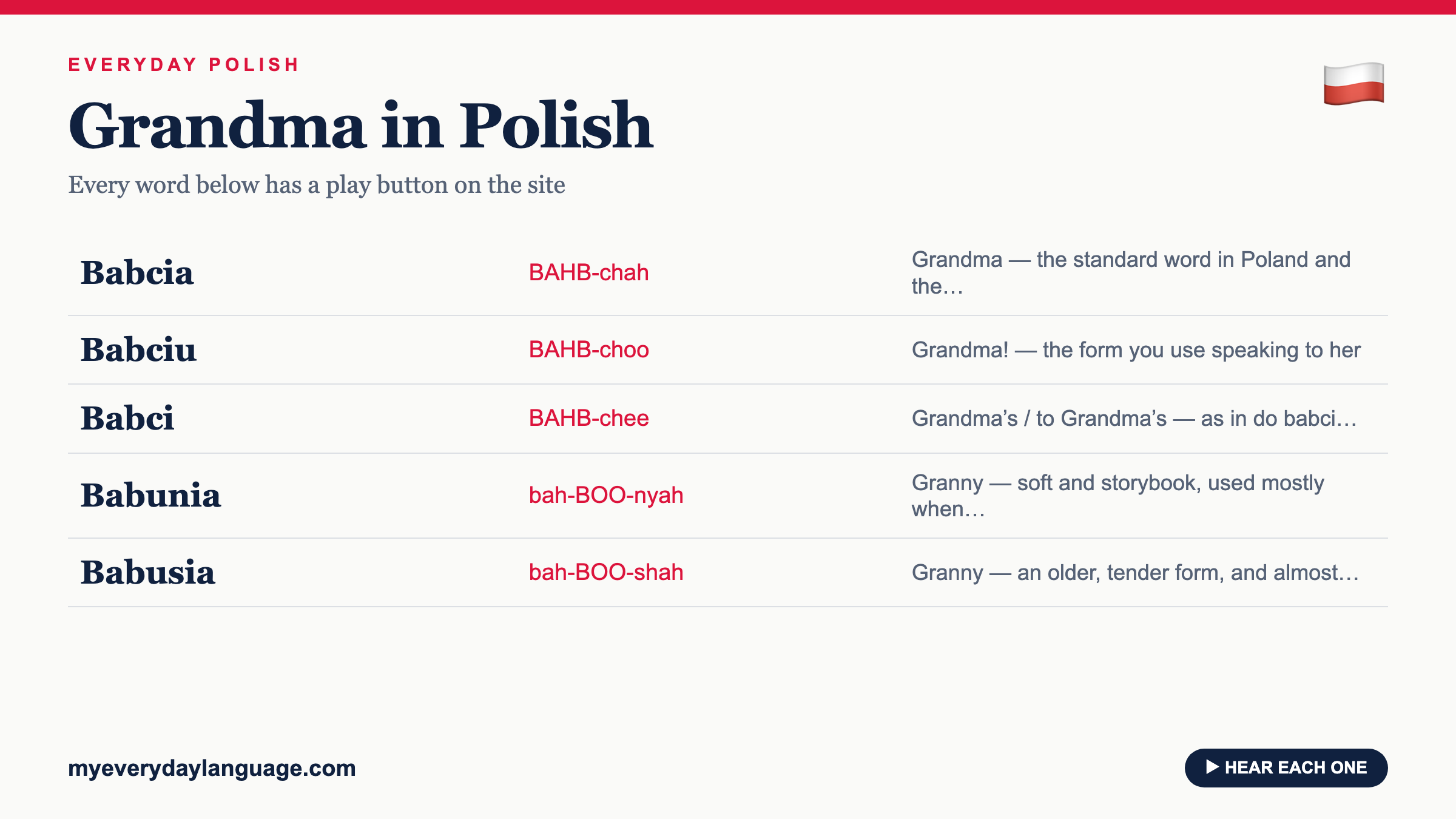
| Polish | Say it like | What it means and when it’s used | Listen |
|---|---|---|---|
| Babcia | BAHB-chah | Grandma — the standard word in Poland and the one to learn first | |
| Babciu | BAHB-choo | Grandma! — the form you use speaking to her | |
| Babci | BAHB-chee | Grandma’s / to Grandma’s — as in do babci, “to Grandma’s house” | |
| Babunia | bah-BOO-nyah | Granny — soft and storybook, used mostly when talking to children about her | |
| Babusia | bah-BOO-shah | Granny — an older, tender form, and almost certainly the parent of “busia” | |
| Busia | BOO-shah | Grandma — the Polish-American form. Everywhere in the US, almost nowhere in Poland | |
| Prababcia | prah-BAHB-chah | Great-grandmother — pra- is the “great” in every branch of the family | |
| Babka | BAHP-kah | “Old woman” — and a cake. Not a name for your own grandmother today | |
| Baba | BAH-bah | Toddler talk for babcia — from anyone older, it’s rude |
Babcia, Babciu, Babci — why the ending keeps moving
Here is the thing that confuses almost everybody, and it takes about ninety seconds to fix.
Polish words don’t hold still. A word changes its ending depending on the job it’s doing in the sentence — and “grandmother” is a word most families used constantly, so most families ended up hearing several versions of it. All three of these are the same woman:
- Babcia — when you’re talking about her. Moja babcia — my grandmother.
- Babciu — when you’re talking to her. Polish keeps a separate ending just for calling someone by name, and this is hers.
- Babci — when she’s the destination or the owner. Do babci — to Grandma’s. Sweter babci — Grandma’s sweater.
That calling form — the -u on Babciu — is not a special grandmother rule. Polish does this to every name it says out loud with affection, which is why miś becomes misiu and skarb becomes skarbie. If you want to see it running through a dozen pet names at once, they’re all collected on our page about saying I love you in Polish.
How “Babci” became a name in America
A surprising number of American families call her Babci — with no a, no u. Grammar books will tell you that isn’t a name at all. Grammar books are missing what happened in the kitchen.
Think about which sentences a small child actually heard, over and over, in a Polish-speaking house in Buffalo or Cleveland or the South Side of Chicago. Not “babcia.” They heard jedziemy do babci — we’re going to Grandma’s. They heard to jest babci — that’s Grandma’s. The ending that came up most often was the one on the way to her house, and children take a name from whatever they hear most.
So Babci stuck. It’s a grammar ending that grew into a name, and it happened in America, one family at a time, without anybody deciding it. Readers write to us about this constantly, and it is the single most common explanation we give.
Busia, Busha, Bopcha — the grandmothers made in America
Now the big one. Busia.
There is a good-natured argument about this word that has been running in Polish-American clubs for the better part of a century, and it goes like this. Someone says her grandmother was called Busia. Someone newly arrived from Warsaw says, kindly but firmly, that no such word exists — it’s babcia.
They’re both telling the truth, and here is the missing piece. The great Polish dictionary of Karłowicz, Kryński and Niedźwiedzki, compiled in Warsaw in the early 1900s — close enough to the emigration years to matter — is where this argument usually gets settled. Under the old word for grandmother it gathers eleven affectionate forms: babka, babcia, babciutka, babeczka, babusia, babuś, babuchna, babunia, babuńcia, babuleńka and babulinka. Polish is generous like that; one name can bloom into a dozen. “Busia” is not among them — and we could not find it in the standard Polish dictionaries either.
Which tells you something lovely rather than something disappointing. Busia is Polonia’s own word. The likeliest story is a child too small to manage babusia, who dropped the front of it and kept the warm part — and then the family kept what the child said, because that is how families work. (A handful of Polish country word-lists do record a busia, so it may have crossed the ocean in somebody’s luggage rather than being born here — but it is the American side of the family that kept it alive.) From there it traveled: the Eastern Seaboard, the Midwest mill towns, Texas, Florida, the coast. Written down for the first time on a birthday card, it usually came out Busha, because nobody had ever needed to spell it before.
It belongs to the same drawer as golumpki and punchki — Polish words reshaped by American mouths, then handed down as heirlooms. Nobody is wrong. One word stayed in Poland and one grew up here.
The two to leave alone: baba and babka
Almost every Polish word for grandmother is safe. Two are not, and they’re worth thirty seconds.
Baba is charming from a two-year-old who can’t manage the whole word. From an adult it means “old woman,” and not warmly. Babka is worse in conversation and better on a plate — it’s the tall ring-shaped Easter cake. A century ago it was an ordinary word for grandmother, which is why it heads that dictionary list, but used about a person today it’s the way a teenager might say “some old lady.” Neither is a name for your grandmother. Stay with babcia and you will never once get this wrong.
Dziadek and Dziadziu — grandpa, standing right there
He gets the same treatment: one word for talking about him, another for talking to him, and an American version that came from the second one.
| Polish | Say it like | What it means and when it’s used | Listen |
|---|---|---|---|
| Dziadek | JAH-dek | Grandpa — the standard word, talking about him | |
| Dziadziu | JAH-joo | Grandpa! — said straight to him, the partner of Babciu | |
| Dziadzia | JAH-jah | Grandpa — the form most Polish-American families kept, often written Jaja | |
| Pradziadek | prah-JAH-dek | Great-grandfather — the one in the photograph nobody can name | |
| Dziadkowie | jahd-KOH-vyeh | Grandparents — the two of them together |
And the rest of the table
While we’re here: the words for everybody else who came to Sunday dinner.
| Polish | Say it like | Who it is | Listen |
|---|---|---|---|
| Wnuczek | VNOO-chek | Grandson — what she called you | |
| Wnuczka | VNOOCH-kah | Granddaughter | |
| Ciocia | CHOH-chah | Aunt — in America often heard as “Chacha” | |
| Wujek | VOO-yek | Uncle — often written “Vuyek” on old envelopes |
More of the everyday words that filled that room — food, house, church, family — are gathered with audio on our 100 most common Polish words page.
📬 Take this lesson with you
A tiny Polish lesson in your inbox every few days — words, audio, and a small story from everyday life. Free forever.
Join 1,700+ learners · unsubscribe anytime
Four sentences to actually say to her
If she is still here to hear them, these are the ones worth having ready. Notice that all four use Babcia or Babciu where English would use “you” — that’s not old-fashioned, it’s how Polish shows respect and affection at the same time.
| You want to say | Polish | Say it like | Listen |
|---|---|---|---|
| I love you, Grandma | Kocham cię, Babciu | KOH-hahm cheh, BAHB-choo | |
| How are you feeling, Grandma? | Jak się Babcia czuje? | yahk sheh BAHB-chah CHOO-yeh | |
| We’re going to Grandma’s | Jedziemy do babci | yeh-JEH-mih doh BAHB-chee | |
| Give me a kiss | Daj mi buzi | dye mee BOO-zhee |
That second sentence is the one to take to a nursing home or a long-distance phone call; there’s more on how Poles ask after each other on our page about how are you in Polish.
The Sunday that had her name on it
Ask an American in their sixties what Polish they still have, and it’s rarely a sentence. It’s a smell and a schedule.
Obiad at two, after Mass, and it was the big meal of the day, not supper. Soup first, always — rosół (ROH-soow), gold, with a few threads of noodle. The good plates. A second freezer in the basement that held more pierogi than any two people could eat. Holy cards tucked in the frame of a mirror. A woman who was up before six and who never once sat down at her own table for longer than four minutes at a stretch.
And her name day mattered more than her birthday — imieniny (ee-myeh-NEE-nih), flowers on the day of the saint she was named for, which is one of the customs still going strong in Poland and mostly lost here. (We collected the ones that survived on our page of Polish traditions families still keep, and the birthday song she sang is over on Sto Lat.)
What got dropped in one generation was the language. It happened fast and usually on purpose: children who were told to speak English so school would be easier, and who grew up understanding everything and answering in English. What survived that clear-out, almost every time, was her name. Busia. Babci. Babunia. A whole language gets down to one word, and the one word left standing is what the children called the woman in the kitchen. That’s not a scrap. That’s the part worth keeping.
A reader told us her babcia died in 1967, and that she still remembers going to see her first — before anyone else, before she even put her bag down — when she came home from college. Nearly sixty years. The word is still doing its job.
Practice: quick check
1. She picks up the phone. What’s the first word out of your mouth?
2. You’re telling a friend where you’re headed on Sunday.
3. Your family has always said Busia. Should you switch to babcia?
4. Grandpa is in the chair by the window. What do you call him?
Frequently asked questions
What do Polish people call their grandma?
Is it babcia or busia?
Is busha a Polish word for grandma?
What does babushka mean in Polish?
How do you pronounce babcia?
Is babcia Polish or Russian?
What do Poles call their grandfather?
Keep going