
🐌 Play slow version
Every way to say I love you in Polish
| Polish | Say it like | What it means | Listen |
|---|---|---|---|
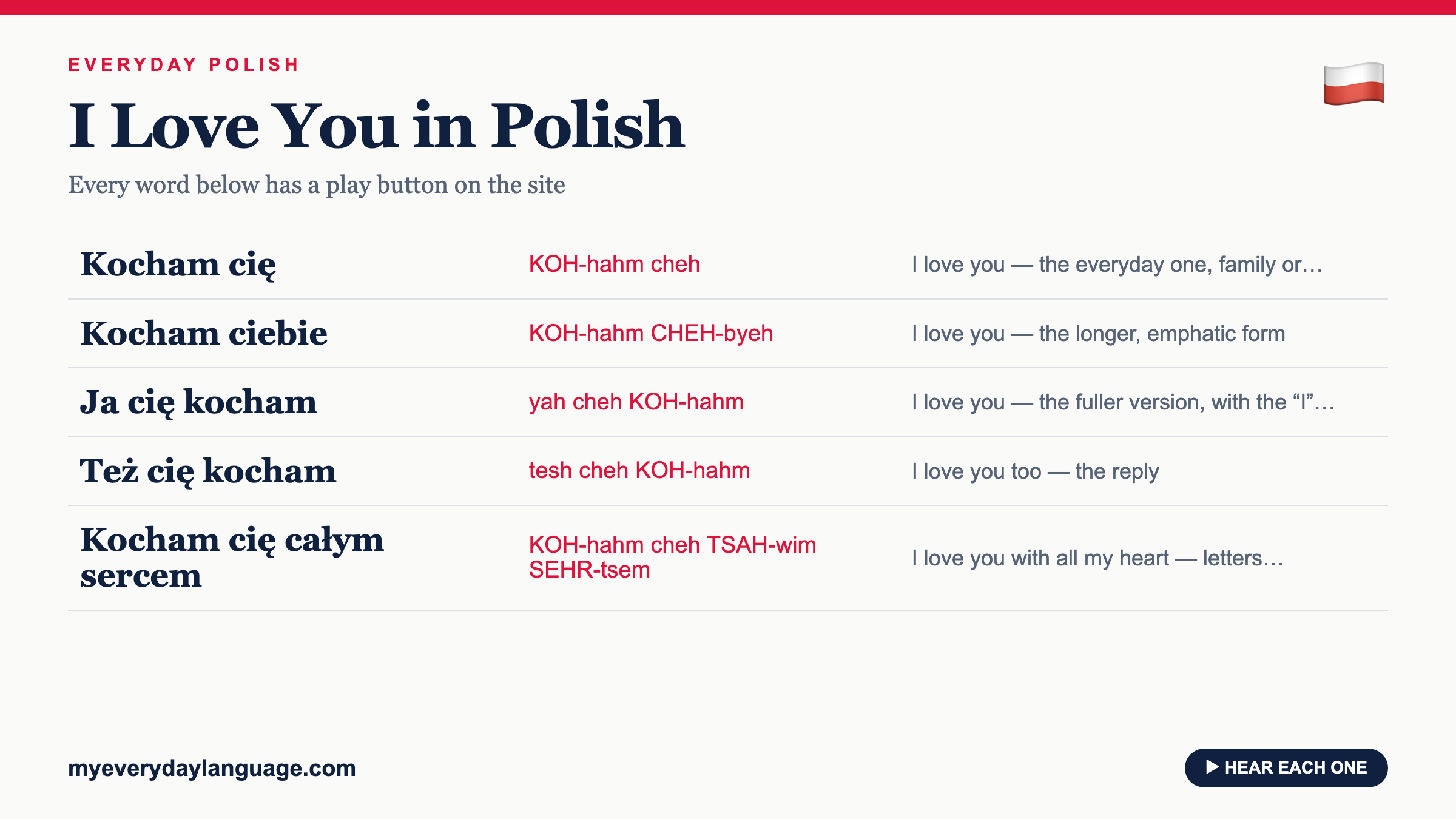
| Kocham cię | KOH-hahm cheh | I love you — the everyday one, family or partner | |
| Kocham ciebie | KOH-hahm CHEH-byeh | I love you — the longer, emphatic form | |
| Ja cię kocham | yah cheh KOH-hahm | I love you — the fuller version, with the “I” said out loud | |
| Też cię kocham | tesh cheh KOH-hahm | I love you too — the reply | |
| Kocham cię całym sercem | KOH-hahm cheh TSAH-wim SEHR-tsem | I love you with all my heart — letters, anniversaries | |
| Kocham cię nad życie | KOH-hahm cheh nahd ZHIH-cheh | I love you more than life — big, unmistakably romantic | |
| Uwielbiam cię | oo-VYEL-byahm cheh | I adore you — playful and warm | |
| Tęsknię za tobą | TENSK-nyeh zah TOH-bawn | I miss you — the phone-call phrase | |
| Lubię cię | LOO-byeh cheh | I like you — friendship only, not a soft “I love you” | |
| Podobasz mi się | poh-DOH-bahsh mee sheh | I like you — the early-days, sweet-on-you kind | |
| Daj mi buzi | dye mee BOO-zhee | Give me a kiss — what grandmothers say at the door |
Why your babcia said “kocham ciebie”
This is the question we get more than any other, in almost the same words every time: my grandmother always said kocham ciebie (KOH-hahm CHEH-byeh), but every website says kocham cię. Was she saying it wrong?
She wasn’t. Here’s the whole explanation, and it’s simpler than it looks.
Polish keeps two words for “you” in a sentence like this — a short one and a long one:
- cię (cheh) is the short, quiet form. It’s the default, the one that slips by unnoticed. Kocham cię.
- ciebie (CHEH-byeh) is the long, stressed form. You reach for it when you want the you to land: “it’s you I love.” Kocham ciebie.
Same meaning. Different weight. English does this with tone of voice — “I love you” versus “I love you” — and Polish does it by changing the word itself. So kocham ciebie isn’t a dialect quirk or an error. It’s the emphatic version: the one you say when you mean it hard, at the door of a hospital room, or into a telephone, or over a kitchen table when someone needed to hear it.
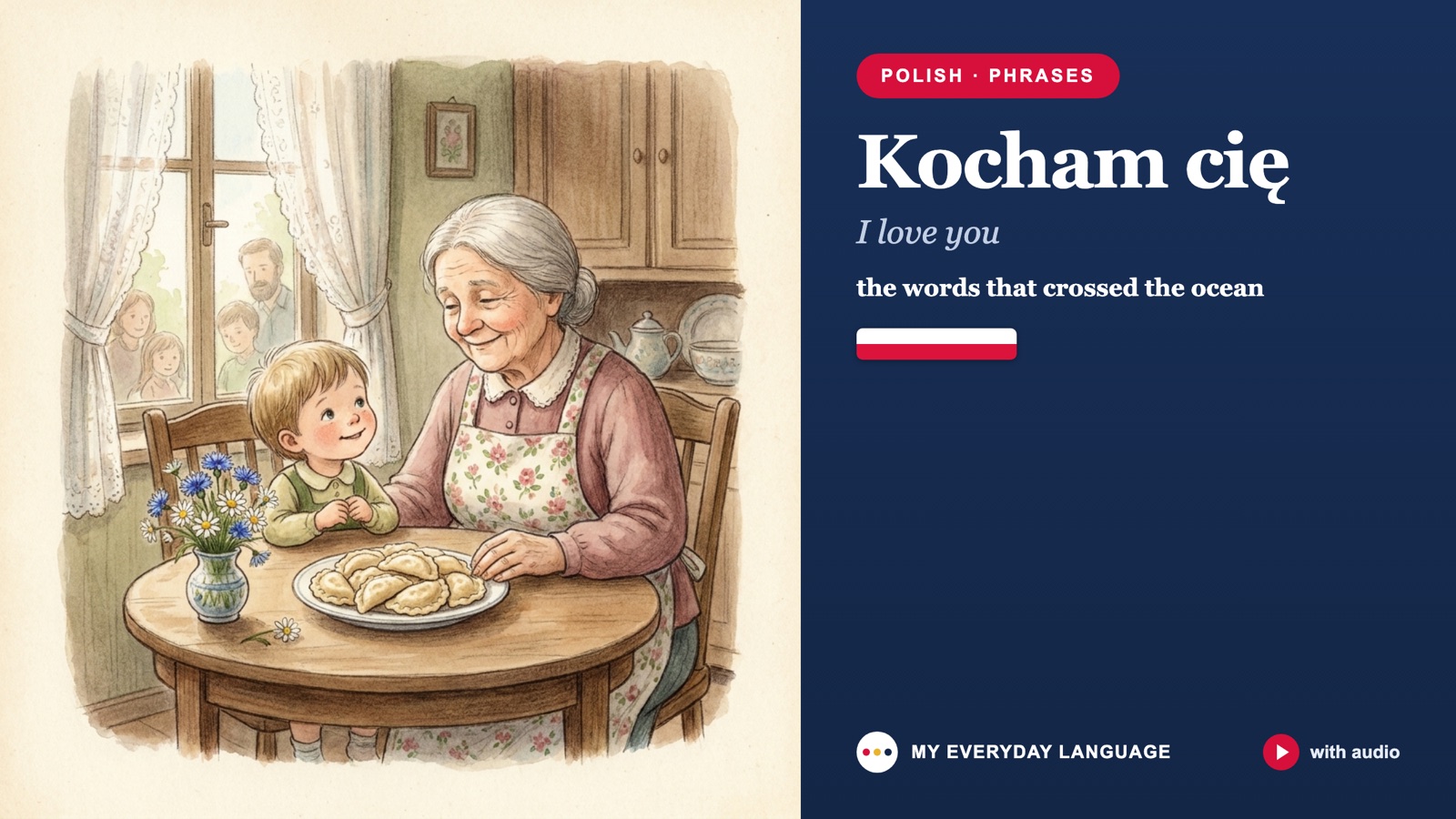
One reader told us her parents fled Poland after the war, and that kocham cię was the phrase her mother kept saying long after the rest of the language had gone quiet. That happens more than you’d think. When a language fades in a family, this is usually the last sentence standing.
Kocham cię or lubię cię? Don’t mix these two up
Lubię cię (LOO-byeh cheh) means “I like you” — and in Polish that is a genuinely different feeling, not a gentler version of the same one. It’s for friends, for colleagues you enjoy, for the neighbor with the good dog.
Answering a heartfelt kocham cię with lubię cię is not a soft landing. It’s a small catastrophe. If the feeling is real but the word love is too big too soon, the graceful middle step is podobasz mi się (poh-DOH-bahsh mee sheh) — “I like you,” in the sweet-on-you sense.
| You mean… | Say | Say it like | Listen |
|---|---|---|---|
| I love you (family or partner) | Kocham cię | KOH-hahm cheh | |
| I’m fond of you (friendship) | Lubię cię | LOO-byeh cheh | |
| I’m sweet on you (early days) | Podobasz mi się | poh-DOH-bahsh mee sheh | |
| I’ve fallen in love with you (a man speaking) | Zakochałem się w tobie | zah-koh-HAH-wem sheh f TOH-byeh | |
| I’ve fallen in love with you (a woman speaking) | Zakochałam się w tobie | zah-koh-HAH-wahm sheh f TOH-byeh |
What Poles call the people they love
Polish is a champion of the affectionate nickname. The trick is that Poles shrink words to make them fond — a smaller word means a dearer person. Which is how a nation of serious-looking people ended up calling their sweethearts “little frog.”
| Polish | Say it like | It literally means | Listen |
|---|---|---|---|
| Kochanie | koh-HAH-nyeh | Darling / honey — the everyday one, for anyone you love | |
| Skarbie | SKAR-byeh | “Treasure” — sweetheart, to a partner or a child | |
| Żabko | ZHAHB-koh | “Little frog” — yes, really, and it’s pure affection | |
| Misiu | MEE-shoo | “Little bear” — cozy, teddy-bear warm | |
| Słonko | SWOHN-koh | “Little sun” — often said to children and grandchildren | |
| Złotko | ZWOT-koh | “Little gold” — the babcia classic | |
| Kotku | KOT-koo | “Kitten” — playful, usually between partners | |
| Serduszko | sehr-DOOSH-koh | “Little heart” — tender, a bit old-fashioned, lovely |
If one of these rings a distant bell — a word an aunt used for you that you never saw written down — this table is probably where it’s hiding. Złotko and skarbie in particular traveled to America and stayed there.
Saying it to family vs. saying it to a partner
Some languages keep two separate phrases: one for romance, one for family. Polish does not. Kocham cię is the same sentence for your wife, your son and your mother. There is no awkward decision to make.
What changes is the frequency. Polish families are not usually loud about it. In many households — especially the older generation — kocham cię was rationed: said at goodbyes, at hospital beds, at airports, on the phone from a long way away. The rest of the time love arrived as a plate of food and the words jedz, jedz (yets, yets) — “eat, eat.”
Which is a good reason to say it out loud now, if you still can. It carries more weight in Polish than it does in English, precisely because it gets said less.
📬 Take this lesson with you
A tiny Polish lesson in your inbox every few days — words, audio, and a small story from everyday life. Free forever.
Join 1,700+ learners · unsubscribe anytime
Which one should you actually use?
Almost always: kocham cię. It is correct with a spouse, a child, a grandchild, a parent, a sibling. It is never too much and never too little. If you learn one Polish sentence in your life, this is a good candidate.
Reach for the others only when there’s a reason:
- Kocham ciebie — when you want the you underlined. Also the version many families kept, so it’s the warmest choice if you’re saying it back to an older relative who said it that way to you.
- Ja cię kocham — the fuller version, and the one many families remember hearing.
- Kocham cię całym sercem — for anniversaries, cards and anything you write down.
- Kochanie — not a declaration at all, just the word you put in front of everything else, the way we use “honey.”
And if you’re building your first handful of Polish sentences around this one, start with how to say hello and how to say thank you — greeting, thanking and loving will carry you through most of a family visit.
And what you avoid is easy: don’t use lubię cię when you mean love, and don’t worry about the rest.
Practice: quick check
1. Your Polish grandson calls. What do you say before you hang up?
2. Someone says “kocham cię” to you. What comes back?
3. A good friend, not a romance. Kocham cię?
4. You’re writing it in a birthday card to your aunt in Poland. Anything to remember?
Frequently asked questions
How do you say I love you in Polish?
Why did my grandmother say “kocham ciebie” instead of “kocham cię”?
What does “ja cię kocham” mean?
How do you pronounce kocham cię?
What’s the difference between kocham cię and lubię cię?
Can you say kocham cię to family and children?
What do Poles call the people they love?
Keep going