
Polish › Culture › Sayings & proverbs
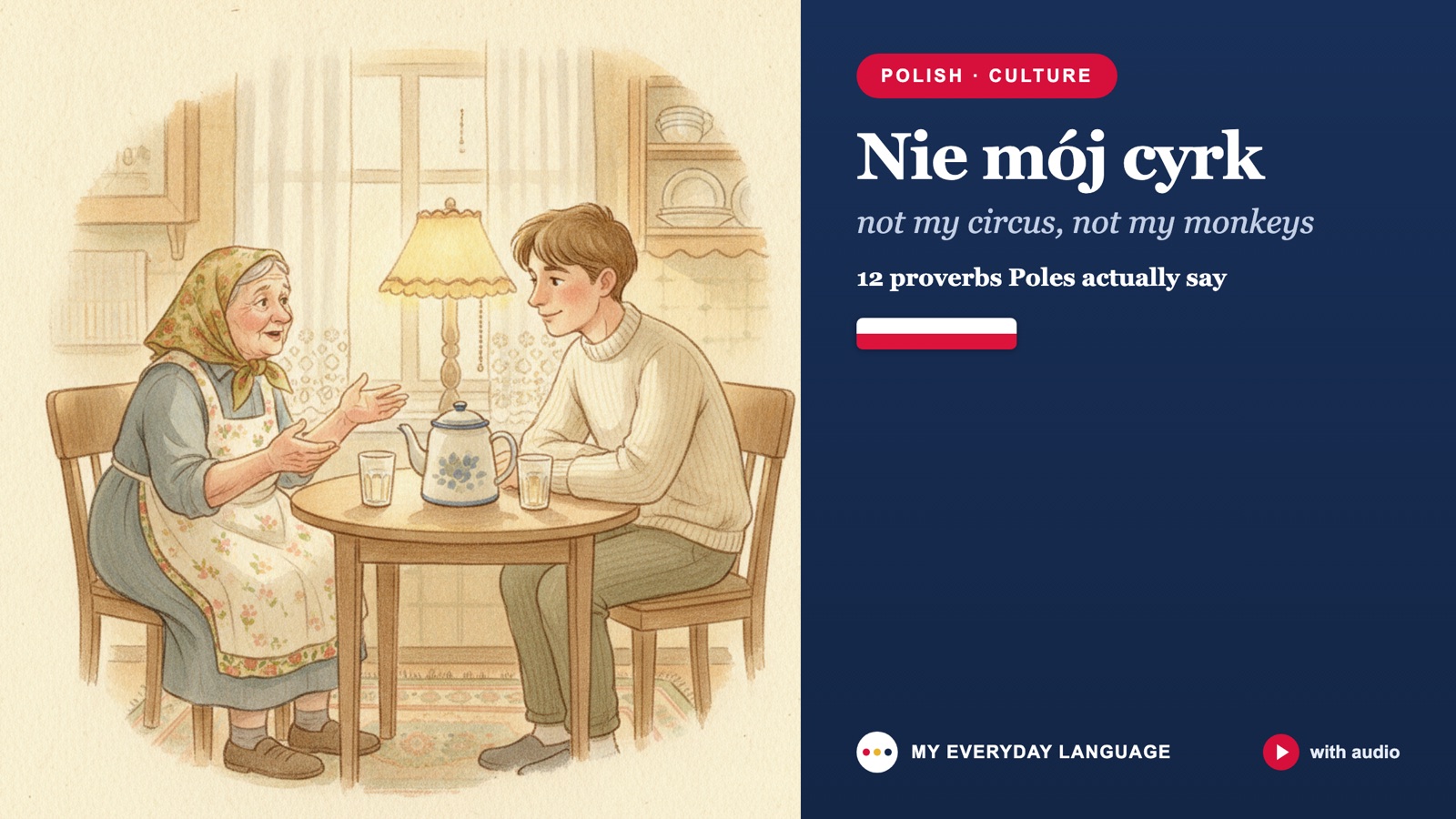
The quick answer: The most famous is nie mój cyrk, nie moje małpy — not my circus, not my monkeys — which English borrowed from Polish. The most Polish is mądry Polak po szkodzie: a Pole is wise after the damage. All twelve are spoken aloud below.
The one English borrowed
If you know a single Polish proverb, it is probably this one, and you may not know it is Polish.
Nie mój cyrk, nie moje małpy — not my circus, not my monkeys. It crossed into English within the last decade or so and is now printed on mugs. It means exactly what it sounds like: that is a mess, it is not my mess, and I am not getting involved.
It is a good introduction to the Polish sense of humour, which tends to be dry, a little fatalistic, and very willing to laugh at itself.
Twelve proverbs Poles actually say
Not a museum collection — these turn up in ordinary conversation, in headlines, and in what grandparents say to children who are not listening. Tap any row to hear it spoken.
| Polish | Say it like | Literally | What it means | Listen |
|---|---|---|---|---|
| Nie mój cyrk, nie moje małpy | nyeh mooy tsirk, nyeh MOH-yeh MAHW-pih | Not my circus, not my monkeys | Not my problem. English borrowed this one. | |
| Bez pracy nie ma kołaczy | bez PRAH-tsih nyeh mah koh-WAH-chih | Without work there are no kołacz cakes | Nothing comes for free. | |
| Kto rano wstaje, temu Pan Bóg daje | ktoh RAH-noh FSTAH-yeh, TEH-moo pahn book DAH-yeh | Who rises early, God provides for | The early bird — with a blessing attached. | |
| Mądry Polak po szkodzie | MON-drih POH-lahk poh shkoh-JEH | A Pole is wise after the damage | Hindsight. Poles say it about themselves, ruefully. | |
| Gdzie kucharek sześć, tam nie ma co jeść | gjeh koo-HAH-rek sheshch, tahm nyeh mah tsoh yeshch | Where there are six cooks, there is nothing to eat | Too many cooks. | |
| Co ma wisieć, nie utonie | tsoh mah VEE-shech, nyeh oo-TOH-nyeh | What is meant to hang will not drown | What is fated will happen. | |
| Nadzieja matką głupich | nah-JEH-yah MAHT-kon GWOO-peeh | Hope is the mother of fools | Darker than English optimism allows. | |
| Wszędzie dobrze, ale w domu najlepiej | FSHEN-jeh DOH-bzheh, AH-leh v DOH-moo nay-LEH-pyey | Everywhere is good, but at home it is best | There is no place like home. | |
| Nie chwal dnia przed zachodem słońca | nyeh hfahl dnyah pshed zah-HOH-dem SWOHN-tsah | Do not praise the day before sunset | Do not count your chickens. | |
| Jak sobie pościelisz, tak się wyśpisz | yahk SOH-byeh posh-CHEH-leesh, tahk sheh VIH-shpeesh | As you make your bed, so you will sleep | You live with your choices. | |
| Prawdziwych przyjaciół poznajemy w biedzie | prahv-JEE-vih pshih-yah-CHOOW poh-znah-YEH-mih v BYEH-jeh | We know true friends in poverty | A friend in need. | |
| Apetyt rośnie w miarę jedzenia | ah-PEH-tiht ROSH-nyeh v MYAH-reh yeh-DZEH-nyah | Appetite grows as you eat | The more you get, the more you want. |
The one that says the most about Poland
Mądry Polak po szkodzie — a Pole is wise after the damage.
Every language has a phrase for hindsight. What makes this one unusual is that it names the nation doing the failing. It is a proverb Poles use about themselves, with a shrug, usually after something entirely predictable has gone wrong.
A country partitioned out of existence for 123 years, flattened twice in the twentieth century and rebuilt each time, has earned a certain dark humour about foreseeable disasters. You can hear the whole national temperament in six words.
Its close cousin is Nadzieja matką głupich — hope is the mother of fools — which is a good deal bleaker than anything English offers on the subject, and is said cheerfully.
Blessings and good wishes
These are the phrases you will hear at tables, at doorways and at departures. They are not optional politeness in Poland; leaving them out is noticed.
| Polish | Say it like | When it is said | Listen |
|---|---|---|---|
| Sto lat! | stoh laht | A hundred years — birthdays, weddings, any celebration | |
| Na zdrowie! | nah ZDROH-vyeh | To health — a toast, and what you say after a sneeze | |
| Szczęść Boże | shchenshch BOH-zheh | God grant you luck — said to someone working | |
| Smacznego | smahch-NEH-goh | Enjoy your meal — never skipped at a Polish table | |
| Szerokiej drogi | sheh-ROH-kyey DROH-gee | Wide roads — safe travels | |
| Połamania nóg | poh-wah-MAH-nyah nook | Break a leg — the same idea | |
| Wszystkiego najlepszego | fshih-STKYEH-goh nay-LEP-sheh-goh | All the best — the standard written wish |
Smacznego deserves special mention. It is said before eating, by whoever is hosting and often by strangers passing your table, and there is no natural English equivalent — enjoy your meal is a translation rather than a habit. Poles notice when it is missing.
Szczęść Boże is the other one worth knowing. You say it to someone who is working — a farmer in a field, a builder on a roof — and it belongs to an older, rural Poland that has not quite gone.
Idioms that make no sense in English
Proverbs teach a lesson. Idioms just are what they are, and the literal translations are half the pleasure.
| Polish | Say it like | Literally | What it means | Listen |
|---|---|---|---|---|
| Bułka z masłem | BOOW-kah z MAH-swem | A roll with butter | A piece of cake — something easy. | |
| Rzuć okiem | zhooch OH-kyem | Throw an eye | Take a look. | |
| Bez dwóch zdań | bez dvooh zdahny | Without two sentences | Without a doubt. | |
| Robić z igiełki widły | ROH-beech z ee-GYEW-kee VEED-wih | To make a pitchfork out of a needle | To make a mountain out of a molehill. | |
| Wyjść na prostą | viyshch nah PROH-ston | To come out onto the straight | To get back on track. | |
| Mieć muchy w nosie | myech MOO-hih v NOH-sheh | To have flies in your nose | To be in a bad mood. |
Robić z igiełki widły — to make a pitchfork out of a needle — is the Polish mountain out of a molehill, and it is a better image: both objects are made of metal, both are pointed, and one is absurdly larger than the other.
Bułka z masłem, a roll with butter, is the Polish piece of cake. It tells you something about the two food cultures that England reached for cake and Poland reached for bread and butter.
How to use them without sounding like a textbook
A proverb dropped into a conversation at the right moment is charming. Three in a row is a party trick, and Poles will gently tell you so.
The safest ones for a learner are the short blessings — Sto lat, Smacznego, Na zdrowie. They are expected, they are brief, and there is no wrong moment for them.
The proverbs proper are better understood than deployed, at least at first. Knowing what Bez pracy nie ma kołaczy means when an aunt says it to you is worth more than being able to say it yourself.
There is one exception worth making, and it is Sto lat. At a Polish birthday it is not a proverb you are quoting, it is a thing everybody in the room does together. Joining in badly is far better received than standing quietly while it happens.
The other reliable moment is a toast. Na zdrowie needs no setup, no accent and no confidence — and in Poland the eye contact matters more than the pronunciation. Look at the person, say the two words, and you have done it correctly.
Where they came from
Polish proverbs are overwhelmingly rural, and recently so. Poland was an agricultural country far later than Britain or Germany, and the sayings still carry the fields in them — cooks, harvests, needles, pitchforks, blades of grass, horses.
The second great source is the Church. Poland has been overwhelmingly Catholic for a thousand years, and the language absorbed it so completely that speakers stopped hearing it. Kto rano wstaje, temu Pan Bóg daje puts God directly in the sentence. Szczęść Boże is a blessing offered to a stranger digging a garden. Neither is understood as religious by the person saying it — much as an English speaker says goodbye without hearing God be with you.
The third source is harder history. A country partitioned out of existence for 123 years, then occupied and rebuilt twice inside one century, produces a particular kind of proverb: unsentimental, funny at its own expense, and deeply unimpressed by optimism. Nadzieja matką głupich — hope is the mother of fools — is not something the English language would say out loud.
The ones about work and weather
These are the oldest layer, and the most agricultural.
Bez pracy nie ma kołaczy — without work there are no kołacz cakes — is the Polish no pain, no gain, and it is more specific than the English. Kołacz is a real thing: a round celebration bread, baked for weddings and harvests. The proverb is not saying you get nothing without work. It is saying you get no cake.
Gdzie kucharek sześć, tam nie ma co jeść — where there are six cooks, there is nothing to eat — is too many cooks spoiling the broth, and it rhymes in Polish, which is why it survived.
Co ma wisieć, nie utonie, what is meant to hang will not drown, is the bleakest joke in the collection. It means fate will find you: if you are destined for the gallows, no river is going to get you first. Poles say it about small inconveniences.
Key facts
- Nie mój cyrk, nie moje małpy — not my circus, not my monkeys — is a Polish proverb that entered English, not the other way round.
- Sto lat means a hundred years and is both a wish and a song.
- Mądry Polak po szkodzie — a Pole is wise after the damage — is a proverb Poles apply to themselves.
- Bułka z masłem (a roll with butter) is the Polish piece of cake.
- Smacznego is said before every meal in Poland and has no habitual English equivalent.
- Szczęść Boże is said to someone who is working.
- Many Polish sayings carry a religious form that speakers no longer hear as religious.
📬 Take this lesson with you
A tiny Polish lesson in your inbox every few days — words, audio, and a small story from everyday life. Free forever.
Join 1,900+ learners · unsubscribe anytime