Italian › Culture › Hand gestures
In our Everyday Italian community, the gesture posts always start the same argument: “my family does it differently!” — which is the most Italian outcome possible. These are the ten with agreed-upon meanings from the Alps to Sicily.
The essential ten
1 The pinched fingers — “Ma che vuoi?” 🤌
Ma che vuoi?
Fingers pinched upward, wrist rocking. THE Italian gesture — now a global emoji. It means “what do you want?! / what are you SAYING?!” — pure theatrical disbelief. The faster the rocking, the deeper the exasperation.
2 The chin flick — “couldn’t care less”
Boh!
Fingertips sweep out from under the chin — non mi interessa, “I couldn’t care less”; in parts of the south it’s sharper, closer to a dismissal. (The famous “Boh!” — “no idea” — is its own separate move: a shrug, palms up.) Use with a shrug, and never at your mother-in-law.
3 The chef’s kiss — “Al bacio!”
Al bacio!
Fingers to lips, kiss, open the hand like a firework. “Cooked to a kiss” — perfection. Reserved for nonna’s ragù, a perfect espresso, and very little else. The world borrowed it; Italy owns it.
4 The prayer shake — “Ti prego!”
Palms pressed together, bouncing toward the listener. “I’m BEGGING you” — used for everything from real pleading to “please, be serious” when your friend says pineapple belongs on pizza.
5 The arm sweep — “Andiamo!”
Andiamo!
A big scooping wave toward yourself or the door. “Let’s GO!” — impatience wrapped in warmth. Often performed by an entire family simultaneously at the end of Sunday lunch, to zero actual effect.
6 “Ma dai!” — come ON!
Ma dai!
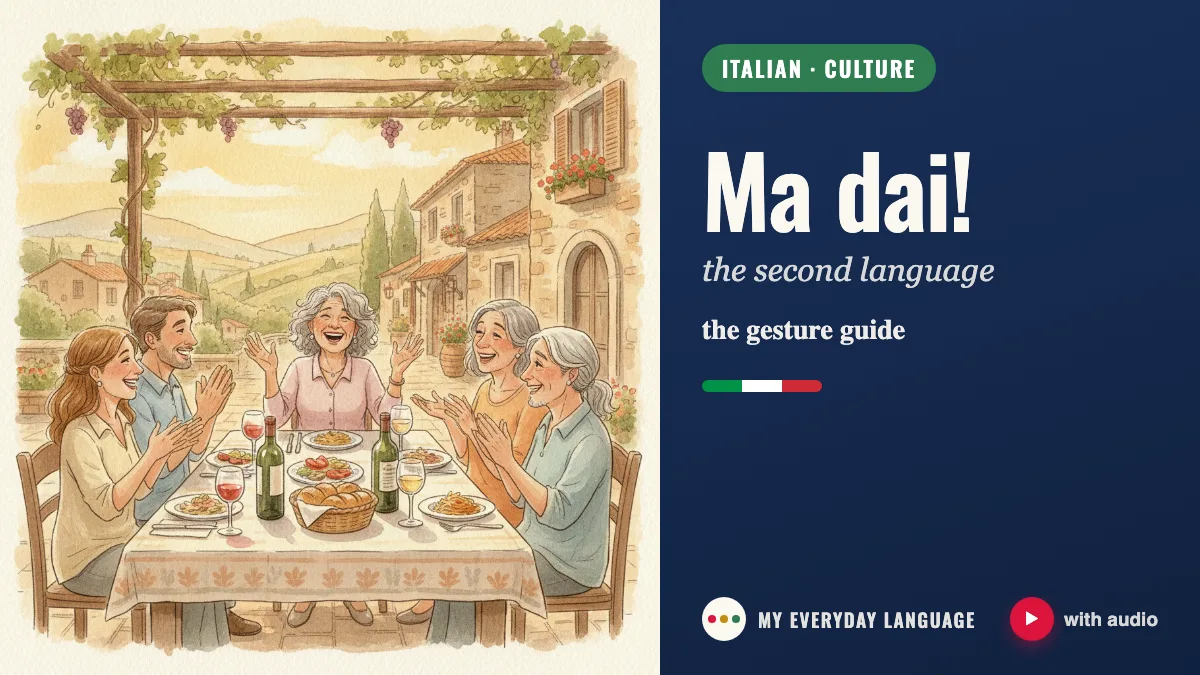
Hands open, dropping slightly, head tilting. Disbelief with affection: “oh come on, you’re kidding!” The correct response to good gossip, bad referee calls, and your cousin’s new haircut.
7 The cheek screw — “Delicious!”
Index finger pressed to the cheek and twisted, usually while tasting. A child-friendly classic meaning “this is delicious!” — mostly used with kids and grandmothers now, and utterly charming.
8 Fingers counting on the thumb — “Listen to me…”
Many Italians count starting from the thumb, and a hand slowly ticking off points means a structured lecture is coming. When nonna reaches finger three, find a chair.
9 The horns — careful with this one 🤘
Index and pinky extended. Pointing DOWN it wards off bad luck (very common). Pointed AT a man it accuses him of being cheated on — historically fight-starting. Rock concerts are the only safe exception.
10 The slow both-hands press — “Calma, calma”
Both palms down, gently pressing the air. “Everyone calm down” — deployed by exactly one self-appointed peacekeeper in every Italian family argument, with a success rate of zero, since the gesture itself invites louder objections.
📬 Take this lesson with you
A tiny Italian lesson in your inbox every few days — words, audio, and a small story from everyday life. Free forever.
Join 1,700+ learners · unsubscribe anytime